Why Federation Needs Common Rules
Trusted digital ecosystems require more than interoperability – they need a shared language for service quality
At FACIS Connect 2026, Thomas Niessen, Lead of the FACIS Work Package on SLA Governance, and Prof. Dr. Sebastian Lins from the University of Kassel, one of the authors of the FACIS SLA taxonomy, explored one of the least visible – but most essential – building blocks of federated digital ecosystems FACIS is focusing on: Service Level Agreement (SLA) governance. While much of the discussion around federation focuses on interoperability, cloud-edge technologies, or digital sovereignty, successful collaboration between independent organizations also depends on something less obvious: common operational rules.
As digital services are increasingly delivered by multiple cloud providers working together, organizations need a consistent way to define, monitor, and govern service quality – such as availability, response times, security, and support – across an entire ecosystem. The session demonstrated how FACIS is helping establish these foundations through a shared SLA governance framework that supports transparency, interoperability, and automation.
Table of Contents
Federation Changes the Way Services Are Delivered
For many years, digital services followed a relatively straightforward model. A company or public organization purchased a service from a single provider, and the Service Level Agreement defined what level of service could be expected – for example, how much uptime the service would provide, how quickly incidents would be resolved, how performance would be maintained, and what security commitments the provider had to meet. Although these agreements were often complex, responsibilities were generally clear.
Federated ecosystems fundamentally change this picture. Instead of relying on a single provider, organizations increasingly consume services delivered by multiple independent organizations working together in a federated ecosystem. These organizations may contribute different capabilities—such as cloud infrastructure, edge resources, digital platforms, or specialized applications—that together form a single digital service. While this distributed approach offers greater flexibility, resilience, and innovation, it also raises an important question: how can organizations ensure consistent service quality when multiple providers are involved?
As Thomas Niessen explained, service quality has become a business-critical issue. Digital services are no longer limited to supporting administrative processes – they increasingly underpin production systems, industrial operations, and critical business workflows. Ensuring reliable collaboration across providers therefore becomes essential for business continuity.
We have a growing complexity of digital services. (...) There is not one provider that can offer all those benefits, but you will have to rely in the future on multi-provider ecosystems. This is inevitable.
Thomas Niessen, Lead of Work Package SLA , FACIS
From Individual Providers to Ecosystem Performance through a Common SLA Taxonomy
Traditional SLAs were designed to describe the relationship between one customer and one provider. Federated ecosystems require a broader perspective.
A single service may depend on several organizations, each using different terminology, different structures, and different ways of defining service quality. One provider may focus on availability, another on response time, while a third emphasizes security. Even when services are comparable, assessing whether providers can work together becomes unnecessarily difficult if everyone describes quality differently.
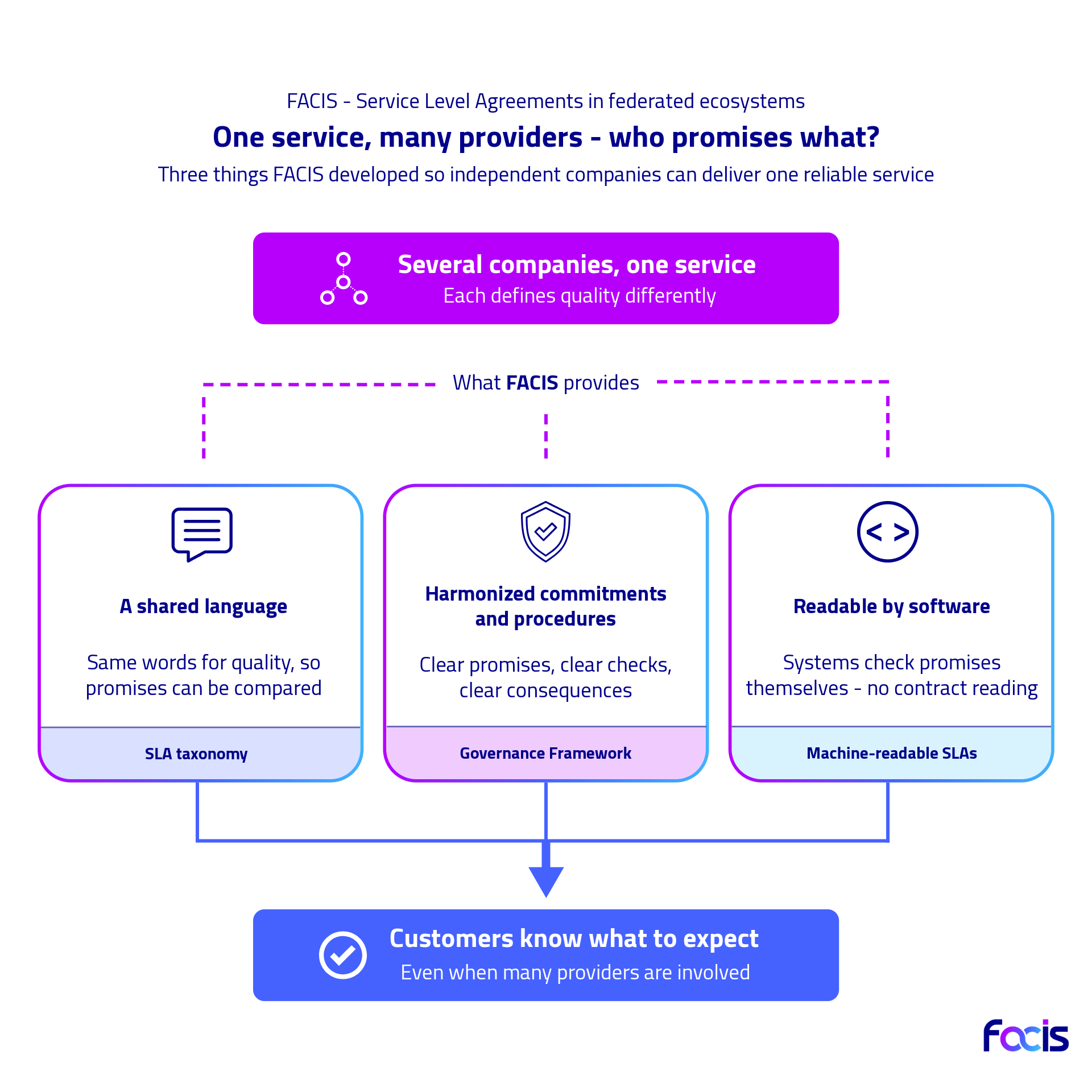
Rather than introducing another standard contract, FACIS addresses this challenge by developing a common SLA taxonomy. The taxonomy provides shared building blocks and a common vocabulary for describing service quality, enabling organizations to structure, compare, and evaluate agreements consistently across multiple providers. Instead of prescribing how providers must design their services, it creates the common language needed for interoperability, transparency, and collaboration.
For organizations participating in federated ecosystems, this creates greater confidence that services can be selected, combined, and governed using consistent quality criteria – even when they originate from different providers.
Making Service Quality Measurable
A shared vocabulary is only the first step. Service quality also needs to be measurable.
The FACIS taxonomy therefore distinguishes between three complementary levels:
- Service Level Objectives (SLOs) define the overall quality goals,
- Service Level Indicators (SLIs) specify what should be measured, and
- Metrics describe exactly how these indicators are calculated and monitored.
This structured approach transforms broad promises such as “high availability” into transparent, measurable commitments. Instead of relying on ambiguous wording, organizations gain a clear basis for comparing providers, monitoring compliance, and ensuring that service quality remains consistent throughout an entire ecosystem.
If you ask (...) three people in this room, they may say different things what they understand about performance.
Prof. Dr. Sebastian Lins, University of Kassel, co-author of the FACIS SLA taxonomy
Governance Beyond the Contract
The practical importance of this approach became particularly clear through one of the scenarios presented during the session. In the scenario, a cloud provider needs to integrate an additional backup provider in order to meet a customer’s resilience requirements. While the customer continues to expect the same level of service, responsibilities are now shared across multiple organizations.
Without common governance, situations like this can quickly lead to uncertainty. Who monitors compliance across the service chain? Who is responsible if the backup provider fails? And how are claims or compensation handled when several providers contribute to delivering the service?
To address these challenges, FACIS has developed an SLA Governance Framework that provides practical guidance for
- defining responsibilities,
- harmonizing commitments,
- monitoring procedures, and
- enforcement mechanisms
across federated service chains. By creating greater transparency and accountability, the framework helps organizations avoid the “blame chains” that can emerge when responsibilities are unclear.
From Governance to Automation: Machine-Readable SLAs
As federated ecosystems continue to grow, governance itself must become more scalable.
Traditional SLAs are written for people. Future federated ecosystems will increasingly require agreements that software systems can interpret automatically. Services may be discovered, integrated, monitored, and replaced dynamically, making manual interpretation of contractual documents impractical.
FACIS is therefore developing machine-readable representations of SLAs that translate governance into structured digital information. This enables software systems to compare services, support automated service discovery, monitor compliance, and automate governance processes across complex multi-provider environments.
Rather than replacing governance, automation builds upon it. Shared definitions, standardized metrics, and common structures create the foundation that allows digital ecosystems to operate more efficiently while maintaining transparency and trust.
We cannot assume 100 percent that there will be human interaction when contracting a service (...). So, what do we do (...) if we have two machines talking to each other?
Thomas Niessen, Lead of Work Package SLA , FACIS
Building the Operational Foundation for Trusted Collaboration
The work presented at FACIS Connect 2026 demonstrated that Service Level Agreements are evolving beyond traditional contracts. They are becoming shared operational frameworks that support transparency, accountability, and, ultimately, automation across federated ecosystems.
Through its SLA taxonomy, governance framework, and machine-readable approach, FACIS is helping establish the operational foundations that will enable organizations to collaborate with greater confidence across Europe’s future cloud-edge ecosystems.