Making Europe’s Digital Resilience Operational

FACIS European Digital Resilience blog article

“The next shock will be digital”: Digital Resilience for Europe

How Federation and Cloud Roaming Strengthen Europe’s Ability to Act

Europe’s digital infrastructure is becoming increasingly critical for economies, governments, and essential services. At the same time, recent incidents have shown how vulnerable digital systems can be when infrastructure is fragmented and dependencies are high.

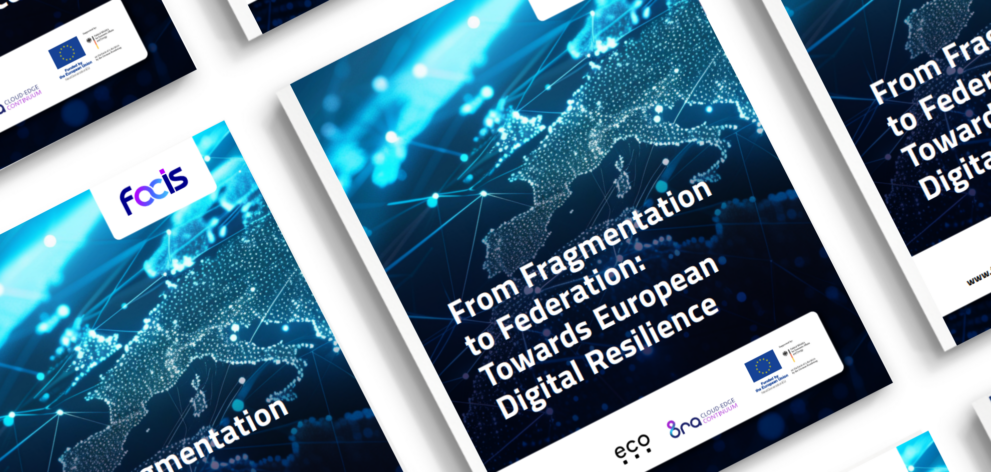
To address these challenges, we recently published the mission paper “European Digital Resilience”. This article takes a closer look at the paper’s main ideas and explains how federation and cloud roaming could strengthen Europe’s digital resilience.

Europe’s Digital Landscape Is Fragmented

Today, Europe’s economy, public administration, and critical infrastructure rely heavily on digital services. Air traffic, energy supply, industrial production, and healthcare depend on systems that must function continuously.

At the same time, Europe’s digital landscape remains highly fragmented. Instead of a shared infrastructure, 27 national and organizational systems operate largely in parallel. These “digital islands” are often unable to support each other in the event of a disruption. This fragmentation not only limits technical flexibility, but also Europe’s strategic ability to make infrastructure decisions – particularly given that around 70 percent of the European cloud market is controlled by non-European providers, creating structural dependencies. 

Key facts at a glance:

  • Europe’s digital landscape consists of 27 national systems – effectively “digital islands”
  • Around 70 percent of the European cloud market is controlled by non-European providers
  • A single failure can disrupt millions of systems worldwide (as the global CrowdStrike incident in 2024 illustrates)
  • The European 8ra initiative brings together around 120 organizations to develop a shared digital infrastructure
Digital Infrastructure Must Remain Operational

Resilience in the context of “Plan B and Plan C readiness” does not mean eliminating disruption entirely. It means ensuring that services can continue operating and adapt when conditions change. This requires a credible ability to switch providers for critical infrastructure – ensuring that no government is structurally tied to a single platform.

Trust: Making Resilience Verifiable and Operational

Such collaboration requires trust. However, trust in digital infrastructure cannot rely solely on assumptions or individual agreements.

Federated systems establish trust through shared standards, transparent rules, and secure digital identities. These mechanisms allow interactions to be verifiable and traceable. Trust becomes a verifiable property of the infrastructure itself rather than an assumption between participants.

This approach requires coordination and shared governance structures. At the same time, it also creates the structural foundation for reliable digital cooperation across organizational and national boundaries.

Implementation: Turning Resilience From Concept Into Capability

Europe has already begun building such federated infrastructures.

The European 8ra initiative brings together around 120 organizations to develop a shared digital infrastructure known as the Multi-Provider Cloud-Edge Continuum. This infrastructure enables digital services to operate across providers and national borders.

Within this framework, projects such as FACIS are developing practical tools for Europe’s digital infrastructure. These include standardized architectural models and machine-readable agreements that make collaboration between organizations and providers more transparent and verifiable.

The key challenge now lies in implementation. Digital resilience will depend not only on technological capability, but on integrating these approaches into operational practice, procurement decisions, and infrastructure strategies.

The global CrowdStrike incident in 2024 illustrates the consequences of this structure. A faulty software update disrupted millions of systems worldwide, grounding flights and interrupting essential operations. Such events demonstrate that digital resilience does not depend solely on preventing disruptions, but on ensuring that digital services can continue operating and adapt when disruption occurs. This leads to a structural question: How must Europe’s digital infrastructure be organized so that essential services remain operational, even when individual providers, systems, or connections fail?

Federation: Enabling Resilience Through Interoperable Infrastructures

Federation provides a structural approach to addressing this challenge. It enables independent organizations to collaborate digitally while retaining full control over their own data and systems.

Instead of consolidating services on a central platform, federation connects distributed systems through shared standards and interoperable interfaces. Data remains under the control of its original owner, yet services can interact securely across organizational and national boundaries.

This creates a connected infrastructure that enables cooperation without creating central control. Europe’s digital islands can become a functioning network while preserving autonomy and flexibility.

Cloud Roaming: Preserving Continuity Through Provider Flexibility

Cloud roaming provides a practical example of how federated infrastructures strengthen resilience. Just as mobile phones automatically connect to a different network when crossing a national border, digital services in a federated infrastructure can move between providers and locations without interruption.

This flexibility enables services to continue operating even if one provider becomes unavailable. It creates real alternatives – often described as “Plan B” and “Plan C” capabilities.

Conclusion: From Fragmentation to Resilience

Federation and cloud roaming do not prevent disruptions. However, they fundamentally change how digital systems respond to the next shock – which will be digital.

They enable services to continue operating, allow systems to adapt, and preserve organizational autonomy while enabling cooperation. Fragmentation can thus evolve into a source of flexibility and strategic choice.

Digital resilience emerges when Europe’s digital islands become a connected infrastructure capable of operating and adapting under changing conditions. This structural transition will play a decisive role in determining Europe’s ability to shape its digital future.

FACIS Update

Stay connected with the FACIS community

Discover perspectives, the latest research insights, practical tools and frameworks for cloud-edge ecosystems, and real-world scenarios – all shaping Europe’s digital future.


Start by following us on LinkedIn.

Prefer deeper updates?

Subscribe to receive selected papers, events, and project insights directly in your inbox.

Subscription Form