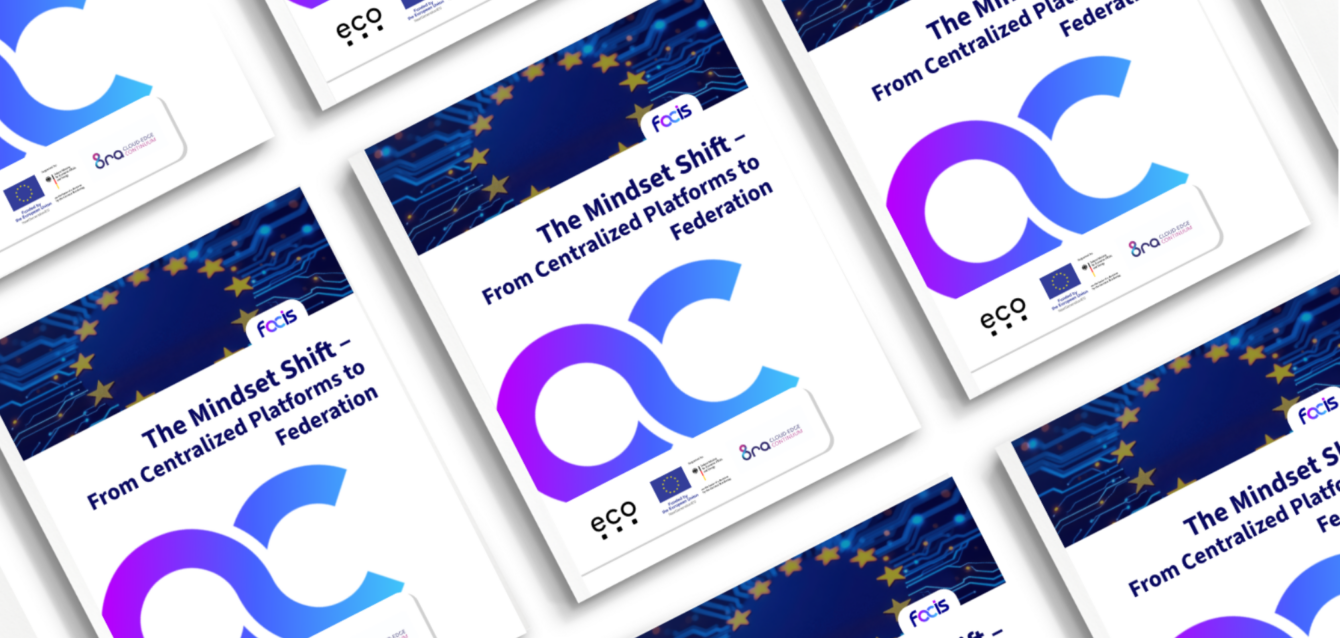
New White Paper “The Mindset Shift - From Centralized Platforms to Federation”
Rethinking Europe’s digital future beyond centralized platforms
The current global debate on digital transformation clearly shows that Europe needs greater digital sovereignty and resilience. FACIS’ new white paper “The Mindset Shift – From Centralized Platforms to Federation”, which has been developed by comissioned authors from ifok, examines the background and outlines the key conditions required to take concrete, practical steps toward this goal.
Based on a systematic analysis, the paper highlights where the current model of centralized platforms is reaching its limits, how a successful mindset shift can be achieved, and what potential this transformation holds for Europe’s economy. The key findings are as follows:
1. Europe Is at a Digital Turning Point
To secure Europe’s digital future, alternatives to centralized platforms are needed. The goal is to achieve:
- greater flexibility
- stronger resilience
- digital sovereignty
- fairer and more competitive markets.
A transformation is therefore urgently required. The greatest challenge, however, is not a lack of technology – the technical foundations already exist – but the necessary cultural shift, which must begin with a change in mindset.
Seriously engaging with alternatives to centralized platforms, such as federation, is the first crucial step.
2. Federation Opens a New Path for Digital Collaboration
Federated data ecosystems enable collaboration on equal footing. Their key advantages include:
- no central control
- no dependencies
- shared rules
- full data sovereignty
- open standards, and
- open-source software.
In this way, organizations can jointly use data and services without handing them over to a central platform or losing their independence. In short: shared use, individual control.
This approach enables faster access, greater transparency, easier switching between providers, and joint development across organizational and national boundaries.
3. Trust and Shared Rules Become the Key Success Factors
The decisive factor in adopting new digital solutions is trust.This challenge can be addressed by embedding trust directly into the system, rather than assuming it.
Not technology alone, but:
- clear governance
- transparent rules
- digital identities
create sustainable trust and make federated models scalable. Digital collaboration is no longer based on the power of individual providers, but on clear rules, transparent governance, and reliable digital identities.
4. The Benefits Are Real – for Business, Government, and Society
Federated data ecosystems reduce costs, increase resilience, and make digital value creation fairer. They:
- strengthen companies through new business models and greater resilience
- give SMEs fair opportunities
- lower costs
- enable better public services
- foster research and innovation
- democratize value creation.
The result is platform effects without platform dependency. Small and medium-sized enterprises, as well as public administrations and research institutions, benefit in particular by gaining access to data anddigital markets without becoming dependent on individual platform providers.
5. The Conditions for Change Are in Place
Technologies, standards, and concrete use cases show that federation already works – it is no longer a future vision:
- tools exist
- standards are available
- real-world examples are functioning.
The key question is no longer if, but how quickly Europe will act. Solutions that can be used immediately are already available; what is needed is a shift in thinking about Europe’s digital infrastructure. Initiatives such as 8ra and FACIS provide open tools, reference architectures, and proven models that are already being applied in practice, for example in industry and aviation.
Now is the time to scale these approaches and put them into widespread practice.
Full versionRead the full analysis and our recommendations for action in the White Paper