Putting Federation into Practice
How open source and hands-on collaboration can help turn European digital sovereignty into something we can actually build
Europe has no shortage of ideas about digital collaboration: Federated ecosystems, open standards and interoperability all promise a digital future with more choice and less dependency on individual technology providers. But how do we get from that vision to something that actually works?
At FACIS Connect 2026, Christian Schmitz, Technical Lead of FACIS, approached this question from a practical angle. In his session “Code, Collaborate, Connect – Inside the FACIS Hackathon”, he explained why open source and hands-on collaboration are key to building federated ecosystems – and why a hackathon is a particularly good place to put those ideas to the test. The hackathon took place alongside FACIS Connect 2026 in Berlin, giving participants the opportunity to turn the concepts discussed at the event into practical experiments and working prototypes.
Table of Contents
Why Open Source Matters for Federation
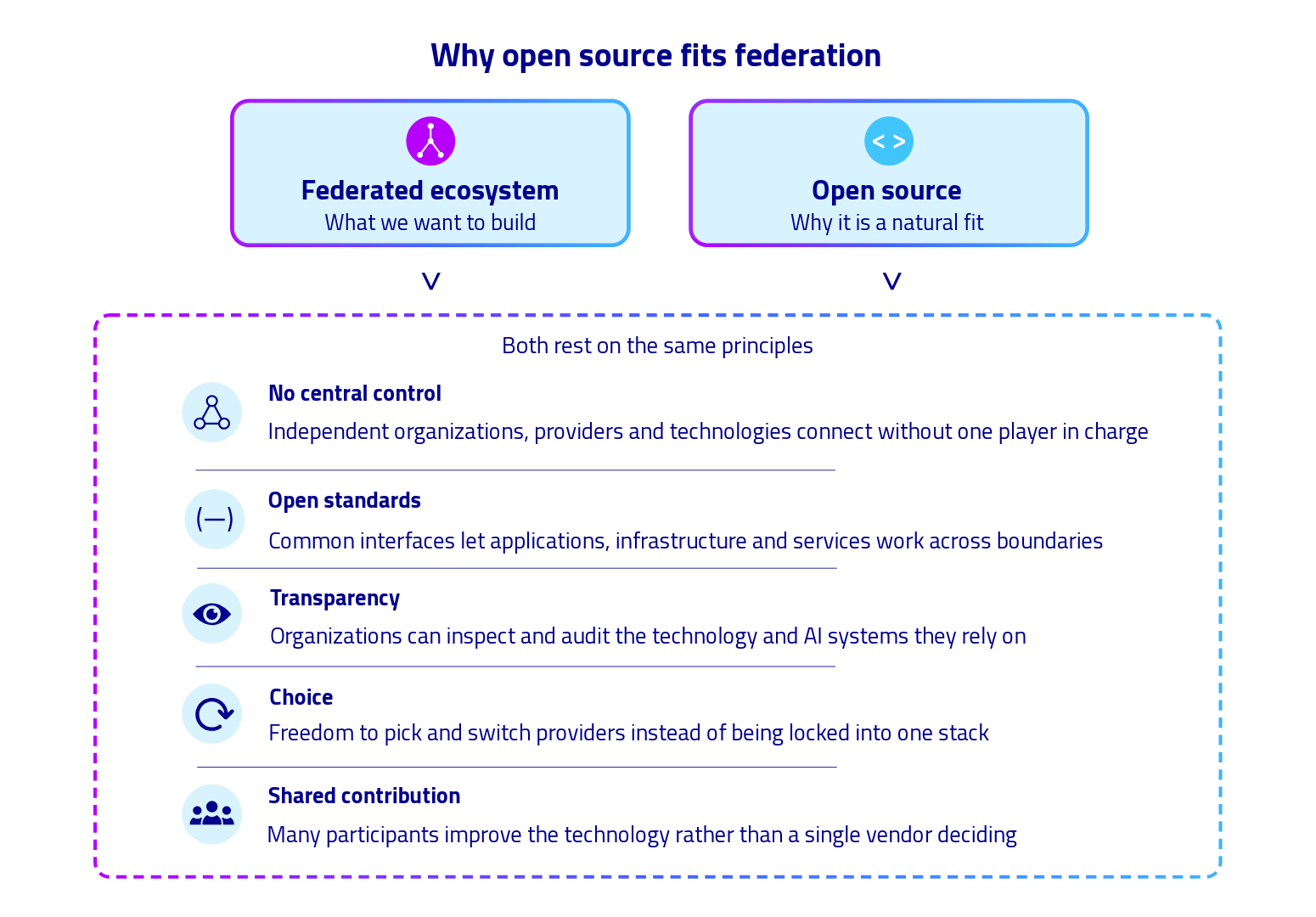
Federated ecosystems connect independent organizations, providers and technologies without putting one central player in control. That makes open source a natural fit.
It creates transparency: organizations can inspect what is running and understand the technology they rely on. It gives them more freedom to choose and switch providers. And it allows different participants to contribute to and improve technology instead of leaving its development in the hands of a single vendor.
As Schmitz put it:
“Nothing is a monolith anymore. Everything is connected.”
What Interconnectedness Requires
That interconnectedness makes open interfaces and common standards essential. Applications, infrastructure and services need to work across organizational and technological boundaries.
The same questions are becoming increasingly relevant with AI. Organizations need to know how critical infrastructure and AI systems work and be able to audit them, rather than relying entirely on black-box solutions. And they need options beyond handing core capabilities to a small number of large providers.
Open source can provide some of those options: transparency, choice and the ability to retain control of your own technology stack.
Bring a Problem. Leave with a Prototype.
Christian Schmitz - Technical Lead, FACIS
Putting Federation into Practice
Of course, open technology alone does not create a federated ecosystem. People have to use it, connect it, test it – and find out where it still needs work.
That is why the FACIS Hackathon took place alongside FACIS Connect 2026 in Berlin: to put federation into practice and test FACIS solutions in real scenarios.
Developers, infrastructure providers and domain experts came together in mixed teams to work on concrete challenges. They tested ideas, encountered problems, changed their approach and tried again. Working code, rather than a concept on a slide, became the measure of progress.
For Schmitz, there is a direct parallel to open-source development. People voluntarily come together around a shared goal, contribute different skills and work on solutions based on common standards.
“A hackathon is open source in miniature.”
The hackathon was a good match for federation itself: independent participants collaborating around shared rules without giving up their autonomy.
Nothing is a monolith anymore. Everything is connected.
Christian Schmitz - Technical Lead, FACIS
Open – But With Guardrails
Building a federated ecosystem involves many different technologies and systems that need to work together. Starting from scratch would therefore have made it difficult for teams to focus on their actual ideas.The FACIS Hackathon therefore combined openness with structure.
Participants could bring their own scenarios, form teams and experiment with different solutions. At the same time, FACIS provided shared challenges, common tooling, APIs, standards and technical guidance.
Schmitz described the approach as:
“Freedom to explore, rails to converge.”
This gave teams a common starting point while leaving room to develop and test their own solutions.
From Building Blocks to Working Prototypes
To give participants that starting point, the hackathon used FACIS Federation Architecture Patterns (FAPs) .
FAPs combine reusable software components with established approaches for recurring federation scenarios. In simple terms, they provide reusable building blocks for common tasks – for example, adding a new partner to an ecosystem, finding services offered by other participants, or enabling data and AI applications to work across different infrastructures.
Instead of starting from scratch, the teams could use existing FACIS building blocks and apply them to their own ideas and scenarios.
The goal, as one of Schmitz’s slides put it, is “running prototypes, not slideware.”
And the practical work provided something else: feedback. By testing the technology themselves, participants could see what worked, where they ran into problems and what could be improved. These learnings can now feed back into the further development of FACIS.
A hackathon is open source in miniature
Christian Schmitz - Technical Lead, FACIS
Digital Sovereignty – by Doing
In this way, the hackathon also reflected the basic idea behind federation itself.
Different participants brought their own expertise and ideas, but worked together on shared solutions – without one central player controlling the process.
This collaborative approach is also an important part of European digital sovereignty: creating alternatives that organizations can understand, use and help shape. Ko0
Or, in the words of the invitation at the end of Schmitz’s session:
“Bring a Problem. Leave with a Prototype.”
Because digital sovereignty will not be built on slides alone – it will be built by doing.