No More Starting from Scratch

260610-eco-facis-079_Hossein 20 pro

How FACIS Simplifies the Setup of a Federation

Making trusted federated ecosystems easier to build and scale

At FACIS Connect 2026, Hossein Rafieekhah demonstrated how FACIS reusable Federation Architecture Patterns simplify the implementation of trusted digital services across federated ecosystems. Building federated digital ecosystems is often seen as a complex technical challenge. But what if implementing federation could become as easy as assembling reusable building blocks? Through live demonstrations, the session showed how FACIS is turning federation from an architectural concept into operational reality.

From Concepts to Implementation

Digital sovereignty by federation will not be achieved through strategy papers alone. It requires practical tools that organizations can adopt, adapt, and deploy.

At FACIS Connect 2026, Hossein Rafieekhah, Lead of the FACIS Work Package on Federation Architecture Patterns (FAPs), demonstrated through a series of live demonstrations how FACIS Federation Architecture Patterns translate the principles of federation into reusable technical solutions that simplify implementation, establish trust, and enable collaboration across organizations and borders.

Federation Needs Reusable Building Blocks

Joining a federated ecosystem raises similar questions for almost every organization collaborating digitally with multiple partners:

  • How do you onboard trusted partners?
  • How can organizations make their services available without relying on a central platform?
  • How do you establish trust across collaborating partners?
  • And how can AI provide transparent, trustworthy results across a federated ecosystem?

Rather than solving these challenges from scratch every time, FACIS develops Federation Architecture Patterns (FAPs) – practical templates, or construction plans, that show organizations how to connect their IT systems, data, and digital services securely across organizational boundaries. FAPs provide proven building blocks that organizations can adapt to their own environments, making federation significantly easier to tailor to individual needs.

If you can sketch a flowchart, you can build a Federation Architecture Pattern.

Orchestration Engine (ORCE): Bringing Federation Architecture Patterns to Life

At the heart of every Federation Architecture Pattern is ORCE, the orchestration engine that runs each FAP. Using a visual, low-code approach, organizations can connect data, services, and identities without developing every integration from scratch. This makes federation solutions easier to build, adapt, and reuse – opening them up not only to software developers, but also to domain experts and other users involved in designing digital collaboration.

Three FACIS Patterns That Demonstrate Federation in Practice

Hossein demonstrated three FACIS Federation Architecture Patterns that address common challenges in real-world digital ecosystems:

  1. Trusted Partner Onboarding
  2. Decentralized Service Discovery
  3. IoT & AI: From Trusted Data to Trustworthy AI

1. FAP on Trusted Partner Onboarding

One of the first challenges in every federated ecosystem is bringing new partners on board in a secure and trusted way.

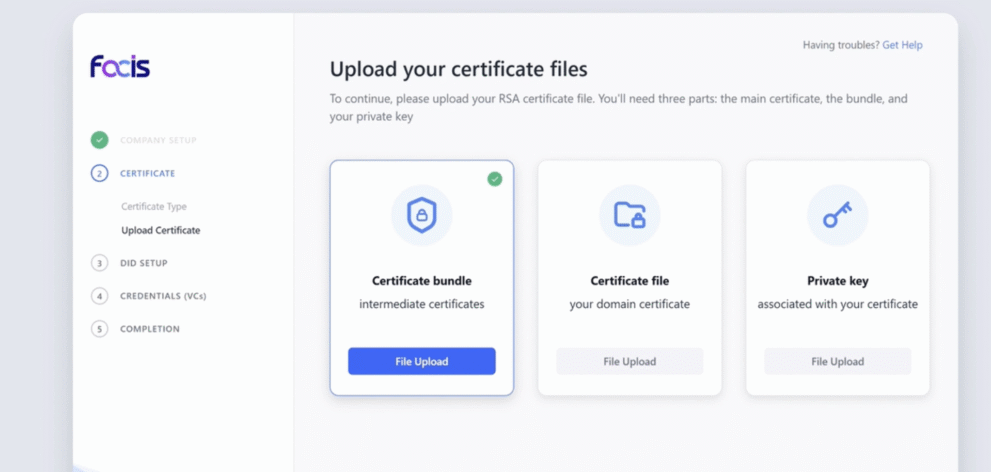
The Partner Onboarding FAP provides a ready-to-use onboarding process that organizations can adopt instead of developing their own. New participants are guided through a six-step registration process, where they provide the required information and verify their identity. Once completed, they receive trusted digital credentials that allow them to participate in the federation while remaining in control of their own systems and data.

Because the entire process is provided as an open-source Federation Architecture Pattern, organizations can reuse and adapt it to their needs instead of starting from scratch – making onboarding faster, more consistent, and easier to scale across different industries and countries.

2. FAP on Decentralized Service Discovery

Every federated ecosystem needs a simple way for organizations to find and use digital services offered by trusted partners – whether that is cloud storage, computing capacity, data analytics, or digital product passport services.

The Decentralized Catalogue Management FAP connects the service catalogs of different organizations without requiring a central platform.

Much like DNS or email work across the Internet without any single provider being in the middle, organizations can discover and compare services across the federation while each provider continues to manage its own catalog.

This means providers remain in control of their own services and data, while users benefit from a seamless search experience across organizational and national boundaries. Instead of relying on a central operator, trust is established through common standards and verifiable information.

Trust travels with the metadata, not with the host.

3. FAP on IoT & AI: From Trusted Data to Trustworthy AI

The third FACIS pattern focuses on one of today’s biggest challenges: turning data from connected IoT devices into trustworthy AI applications.

The IoT & AI FAP provides a ready-to-use data pipeline that helps organizations collect, share, and analyze data from sensors, machines, and other connected devices across different locations and organizations. Instead of building this infrastructure from scratch, organizations can adopt and adapt a common technical template that securely moves data from its source through a governed pipeline to AI-powered insights. Crucially, every AI answer carries a verifiable link back to the exact source data that produced it: no black-box outputs, no ungrounded claims, and AI results that you can trace to their sources.

Building an Open Federation Ecosystem Together

A recurring message throughout the session was that federation cannot succeed in isolation; it is built through collaboration. Rather than replacing existing technologies or initiatives, FACIS is designed to complement them – providing reusable implementation patterns that integrate with different providers, platforms, and infrastructures.

All demonstrated Federation Architecture Patterns are available as open-source implementations, allowing organizations to explore the code, contribute improvements, and propose new patterns for future development.