Aviation's Answer to a Problem Every Industry Has
How Europe’s aviation industry is building digital trust between thousands of companies that don’t know each other
A single flight from Frankfurt to Singapore involves dozens of companies. The airline sells the ticket, but someone else fuels the aircraft, someone else loads the bags, someone else built the engines, someone else maintains them, someone else runs the gate. Most of these companies have no contract with each other. Many will never speak. And yet they have to exchange information constantly, reliably, and securely – often within minutes.
Multiply that by 100,000 flights a day, and you have one of the hardest coordination problems in modern industry. You also have one of the world’s most highly regulated ones: in aviation, every exchange has to satisfy a certification authority as well as a business partner.
For a long time this worked because the connections were few, slow, and mostly manual. That era is over. Aircraft now exchange operational data with all of these partners continuously, throughout their lifecycle – and every new connection widens the surface an attacker can reach. The question is no longer how to connect these companies. It is how each of them can trust each other and know, automatically and in the moment, that the partner on the other end is who they claim to be and will handle the data as agreed.
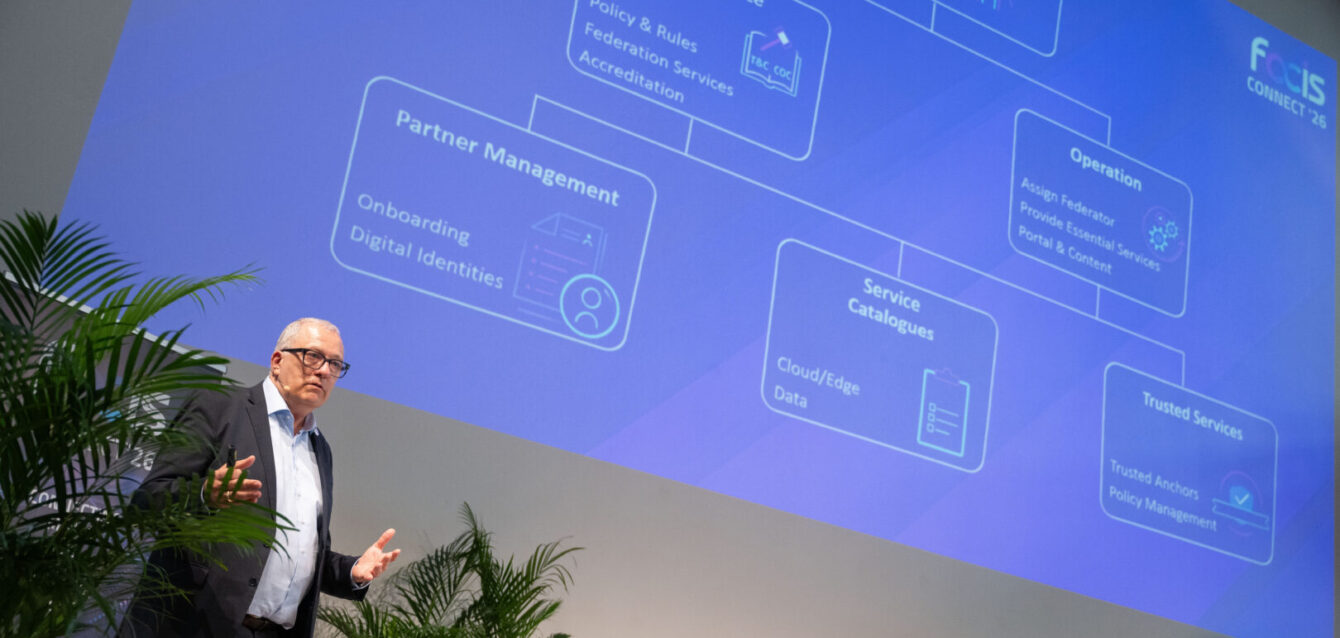
In their session at FACIS Connect 2026, Andreas Weiss, Managing Director of eco – Association of the Internet Industry, and Stéphane Poulain from Airbus explored one answer to that question. FACIS tests its concepts in real-world scenarios to see how they perform in practice. Aviation is a particularly strong example, as many independent organizations and systems need to work together securely and reliably. Weiss and Poulain used this setting to show what federation is ultimately about: creating the trusted foundations for organizations to collaborate securely and at scale.
Table of Contents
One rulebook instead of hundreds of contracts
Federation is the name for that answer. Rather than centralizing control, it enables organizations collaborate through shared governance, trusted identities, interoperable services, and common operational principles – while each of them keeps its own autonomy.
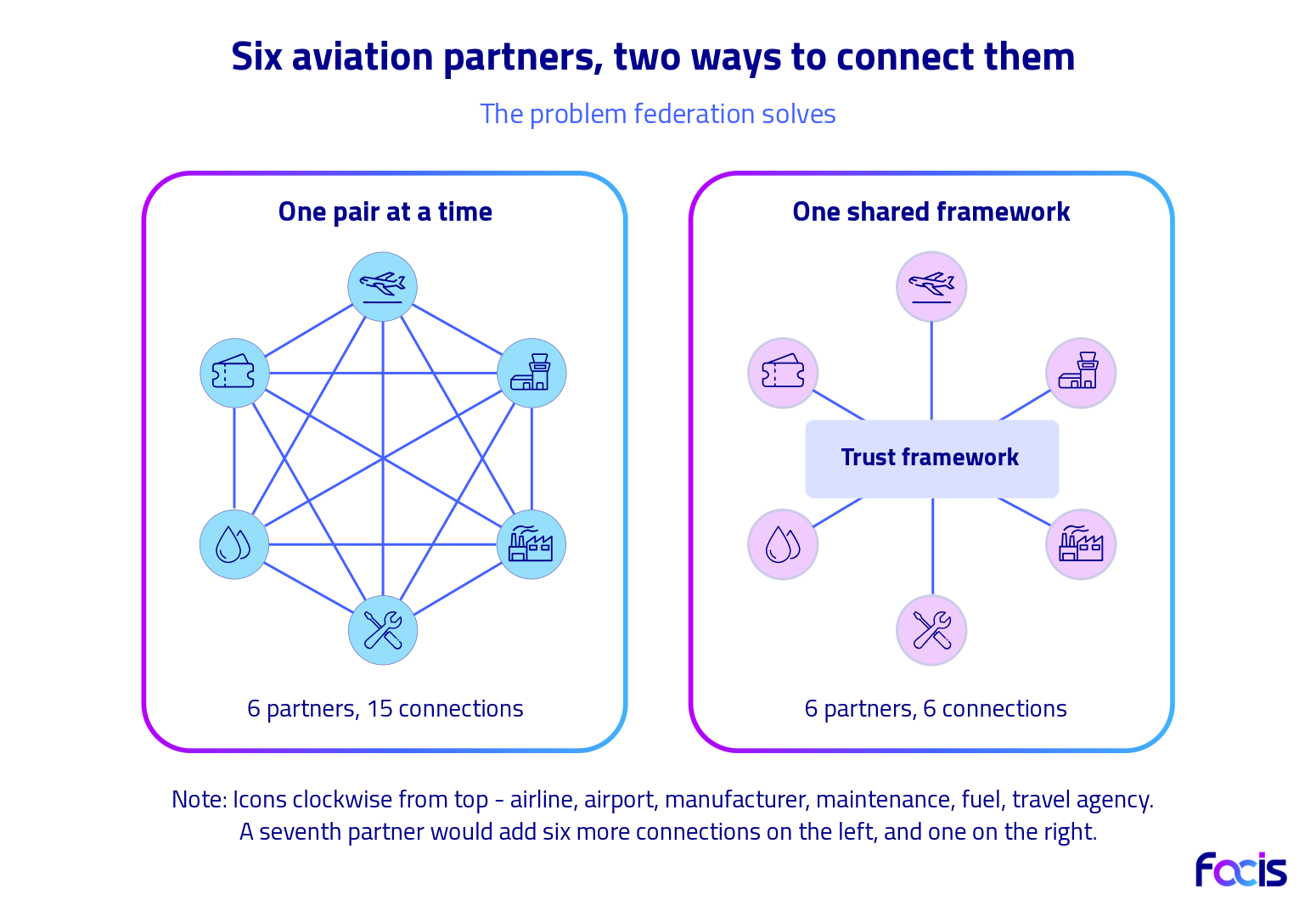
In a network of a few dozen partners, connecting everyone to everyone means hundreds of separate contracts, security reviews and interfaces to maintain. Federation offers another approach: participants agree on common rules and mechanisms for collaboration instead of rebuilding every relationship from scratch.
The objective is not only to collaborate, but to collaborate in a way that remains trustworthy at all times.
Andreas Weiss - Managing Director, eco - Association of the Internet Industry
Trust is more than cybersecurity
One of the central messages of the session was that trust extends far beyond technical security. From Airbus’ perspective, trusted collaboration is built on three complementary dimensions:
- cybersecurity trust,
- contractual trust, and
- reputation.
Organizations need confidence that participants are technically secure, operate under transparent governance frameworks, and consistently fulfil their commitments. This broader understanding of trust fundamentally changes how digital ecosystems operate. Rather than granting static access rights, trust becomes dynamic and context-aware.
Andreas Weiss illustrated this with a practical example: a pilot may hold a valid license, but that does not automatically authorize them to operate every aircraft or every flight. Authorization depends on the specific aircraft, the route, the operational context, and the time.
The same principle applies across digital ecosystems. A verified identity alone is not enough – every request has to be checked again. This is Zero Trust: nothing is trusted by default, and access is continuously reassessed based on context. It is one of the core principles FACIS builds on, in aviation and everywhere else. Andreas Weiss pointed out: “The objective is not only to collaborate, but to collaborate in a way that remains trustworthy at all times.”
But what does that look like when the participant is not a person, but an aircraft?
The aircraft as a flying edge device
Airbus and FACIS built exactly that case into their proof of concept: treating the aircraft as a “flying edge device” – an aircraft that is also a computer. An aircraft’s data can reach the right partner at the right moment, without anyone building a private connection for it first.
Perhaps the most important insight from the session was that trust is not only a security topic – it is an economic one. As part of the FACIS proof of concept, Airbus demonstrated this through several real-world use cases.
Trust creates business value
In maintenance and warranty management, manufacturers, suppliers, and airlines need to exchange reliable information about parts, repairs, and warranty claims. If they can trust this information without checking it manually each time, warranty cases can be handled faster and collaboration becomes easier.
In airport turnaround operations, many different partners need to work together to get an aircraft ready for its next flight. If airports, airlines, and service providers can share the information they need more easily, they can coordinate their work better, avoid delays, and reduce costs.
In passenger services, the same principle can improve the passenger experience. Airlines and other service providers can offer more personalized digital services while passengers remain in control of who can access and use their data.
The goal of federation is therefore not to make organizations share as much data as possible. It enables them to share exactly what is needed, with the right partners and under clearly defined rules – while remaining in control of their data.
Trust is not only a security topic. Trust is also a business topic.
Stéphane Poulain - Airbus R&T Project Manager Airbus Operations GmbH/ AXIS
As trust increases, organizations become more willing to collaborate. And the potential goes beyond making existing processes more efficient: Trusted collaboration can also create entirely new digital services. One example presented during the session was fuel optimization: an application could combine information on weather, aircraft load, passenger numbers, cargo, air traffic, and flight plans to help optimize the amount of fuel needed for a flight. Federation could make it possible to bring this information together while allowing the different participants to remain in control of their data.
This can also create opportunities for new players. Providers specializing in areas such as optimization, analytics, or communications could contribute their services to the aviation ecosystem – provided they meet the necessary trust and governance requirements. In this way, greater trust can not only improve collaboration but also open up new business opportunities across the aviation ecosystem.
From proof of concept to Europe's digital future
The FACIS aviation proof of concept with Airbus illustrates how federation can move beyond architectural concepts and become operational reality.
By bringing together federation, Zero Trust, digital identities, governance, and trusted services, independent organizations can exchange information securely, remain in control of their data, comply with regulatory requirements, and adapt to changing operational needs.
Most importantly, greater trust allows organizations to work together more easily, develop new services, and create sustainable digital business models – turning trust from a security requirement into a driver of business value.
As Europe continues to build federated cloud-edge ecosystems through initiatives such as FACIS and 8ra, aviation offers a compelling example of what federation can achieve in practice: trusted digital collaboration that creates tangible business value.